
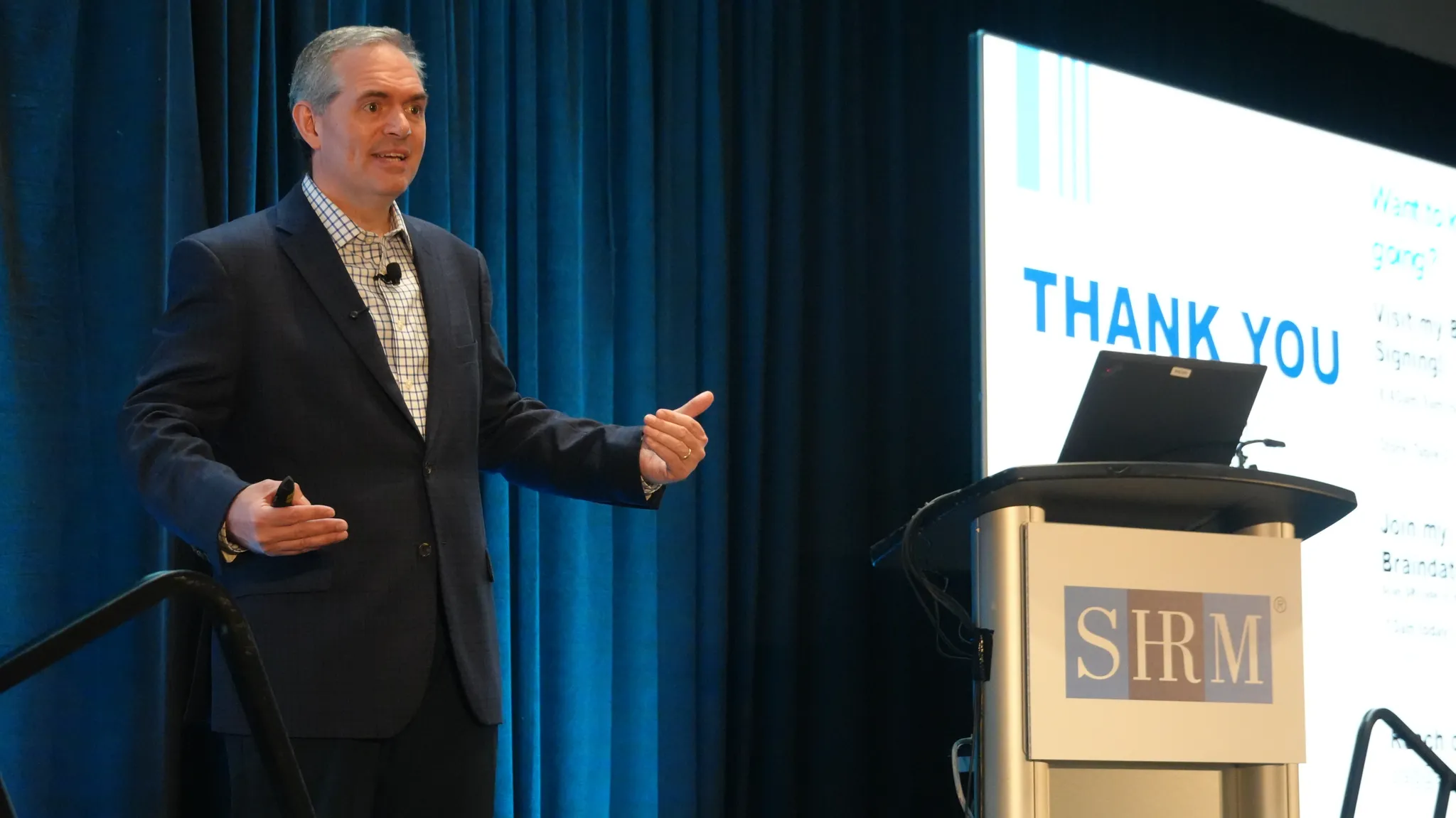
Can artificial intelligence improve hiring outcomes without replacing human judgment?
That was the central question explored by Craig della Penna, Founder of Aesop Partners and creator of the HireBest® methodology, during his sold-out SHRM 2026 presentation,"Beyond the Gut Feel: How AI-Powered Structured Interviews Are Transforming Hiring Outcomes."
The answer is clear:
The future of hiring isn't AI versus humans. It's AI enhancing human decision-making.
Why So Many Hiring Decisions Fail
46% of new hires fail within 18 months, and only 19% achieve unequivocal success (Leadership IQ, “Why New Hires Fail” — as cited in Cipher, ch. 1).
The problem is not necessarily a lack of talent. It's a lack of process.
Most hiring failures can be traced back to three root causes:
- Organizations haven't clearly defined what success looks like before recruiting begins.
- Interviews generate inconsistent and difficult-to-compare data.
- Bias and intuition often outweigh objective evidence during decision-making.
The First Step: Define Success Before You Interview
One of the major themes of the SHRM session was the importance of role clarity.
Many organizations begin recruiting with a job description but lack a shared understanding of what successful performance actually looks like. Effective hiring begins by identifying the handful of critical outcomes a person must deliver in the role—not simply a list of responsibilities.
How AI Removes Friction from Structured Hiring
If structured interviews are proven to be more effective, why aren't more organizations using them consistently?
The challenge isn't a lack of knowledge. The challenge is adoption.
Hiring managers frequently understand the value of structured interviewing, but many revert to conversational, intuition-driven interviews because traditional structured processes are viewed as cumbersome.
This is where the proliferation of higher-quality AI tools have changed the game for recruiting, and structured interviewing in particular. AI can help:
- Define role-specific success criteria.
- Generate targeted interview questions (based on the role, NOT biased for each candidate).
- Identify potential gaps between candidate experience and role requirements.
- Summarize interview conversations.
- Assist with candidate evaluation.
- Surface potential bias and compliance concerns
AI Should Support Decisions Not Make Them
A critical distinction is that AI is a tool, not a decision-maker.
Organizations should never outsource judgment, leadership, or accountability. Instead, AI should provide better information so leaders can make better decisions.
AI can help create structure, highlight gaps, and improve consistency, but human leaders remain responsible for selecting the right person for the role.
The goal is not automation. The goal is better decisions.
The Business Impact of Structured Hiring
Organizations that successfully implement structured hiring can experience benefits beyond recruiting:
- Higher-quality hires.
- Faster employee ramp-up.
- Lower attrition.
- Improved organizational performance.
- Greater confidence in hiring decisions
When hiring teams consistently evaluate candidates against clearly defined success criteria, organizations create a repeatable process that improves over time.
Hiring becomes less dependent on individual interview styles and more focused on evidence.
The Future of Hiring Is Human + AI
One of the most resonant ideas from the SHRM 2026 conference, in both Craig's session and in numerous others, was that technology should strengthen not replace the human side of hiring.
AI can help organizations create structure, gather better data, reduce administrative burden, and improve consistency. Human leaders still provide judgment, context, relationship-building, and strategic thinking.
About Aesop Partners and HireBest®
Aesop Partners helps boards, CEOs, private equity firms, and leadership teams make better talent decisions through structured assessment, leadership advisory services, and the HireBest® methodology. The Cipher® framework provides a practical, evidence-based approach to defining success, evaluating candidates, and improving hiring outcomes.
Frequently asked questions
Can AI improve hiring without replacing human judgment?
Yes — that was the presentation’s central argument. AI removes the friction that stops teams running structured interviews consistently (preparation, transcription, coverage tracking, live coaching), while the judgment — what the role needs, how the evidence rates — stays human.
Why do structured interviews outperform unstructured ones?
Unstructured interviews produce data that can’t be compared: different questions per candidate, impressions instead of evidence. Structured interviews ask every candidate questions mapped to a defined role, which is why the research literature consistently finds them more predictive.
What does “define success before you interview” mean in practice?
Before recruiting begins, agree the handful of outcomes the role must deliver — in the Cipher® framework: the charge, the outcome, the deliverables, and the efforts. Interviews then gather evidence against that standard instead of generating opinions.
The framework from the talk: what building a Cipher actually does · the book.